


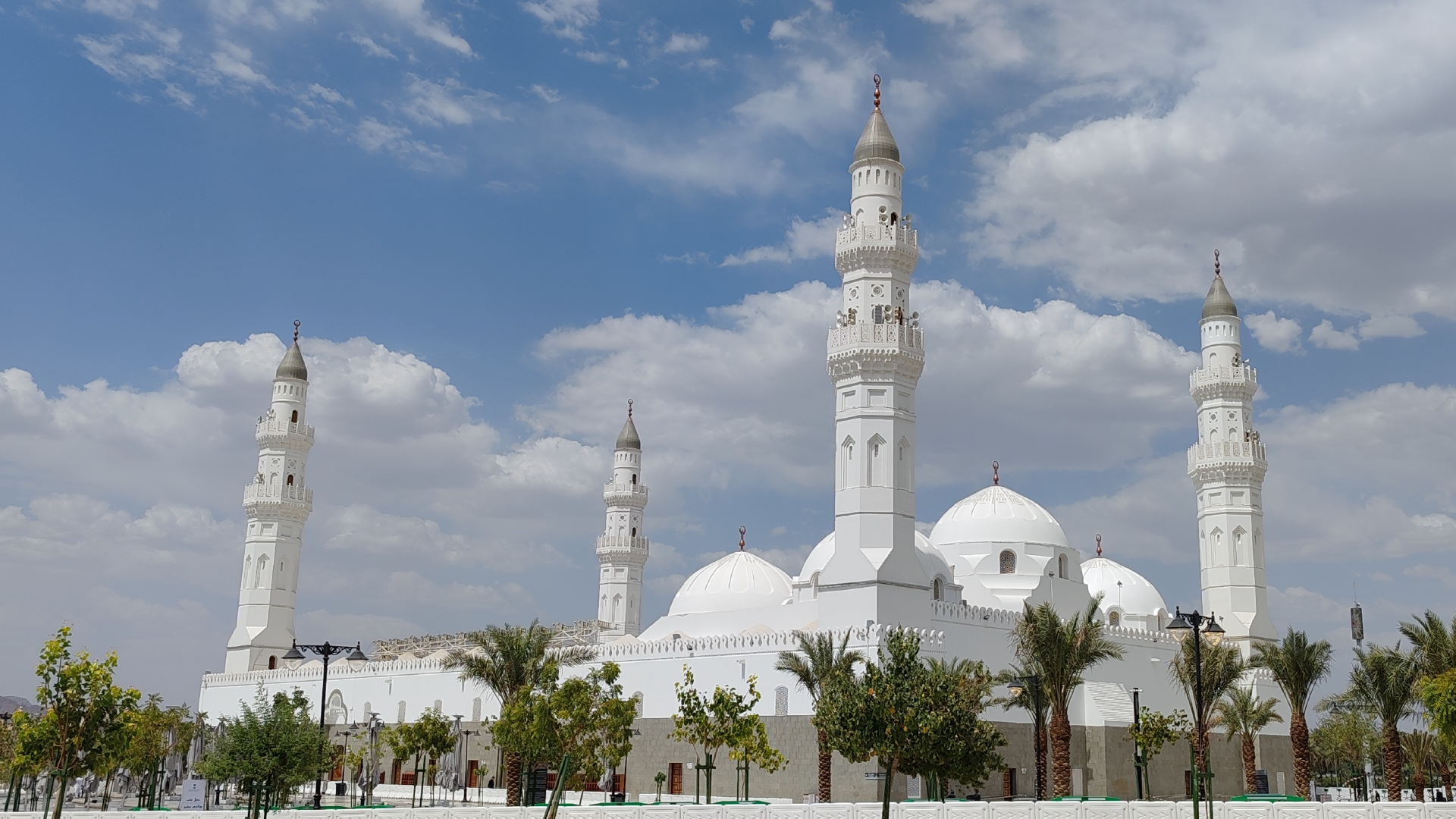
Amidst the palm groves and in the heart of "Taibah Al-Tayyibah" (the beloved Madinah), Quba Mosque rises as a living testament to the early dawn of Islam and the unceasing pulse of Prophethood. It is the majestic edifice whose foundational bricks were laid by the honorable hands of Prophet Muhammad (peace be upon him) upon his arrival in Madinah as an emigrant. He was joined by the noble Sahabah (Companions) -may Allah be pleased with them- in constructing the first mosque founded on Taqwa (Prayerfulness).
Quba was never merely a structure of stone; rather, it was a sanctuary for the heart of the Chosen Prophet (Al-Mustafa), who would visit it with profound longing every Saturday. He left us a spiritual legacy overflowing with tranquility, decreeing that a prayer offered within its walls equals the reward of a complete Umrah. Throughout successive eras, the mosque has remained a focal point of care and devotion for caliphs and kings. From the architectural enhancements of Uthman bin Affan -may Allah be pleased with him- to the minarets erected by Umar bin Abdulaziz that resonated across the skies of Madinah, this legacy of stewardship has culminated in the prosperous Saudi era, which has bestowed exceptional care upon Quba. King Fahd bin Abdulaziz -may Allah have mercy on him- ordered its comprehensive reconstruction and expansion while meticulously preserving its unique architectural identity. Today, the mosque stands tall with its four towering minarets, housing within its corridors a rich library and integrated service facilities to warmly embrace visitors and worshippers. Thus, Quba Mosque endures as an eternal journey of faith, beginning with the fragrant essence of the Prophetic Biography (Seerah) and ultimately settling deep within the conscience of every visitor and devoted believer.
1- Initial Construction: Built in the first year of Hijrah by Prophet Muhammad ﷺ after his migration from Makkah to Madinah. Initially simple in structure, it was built using local materials available in the area.
2- Renovation in the Saudi Era: The mosque witnessed comprehensive renovation during the reign of King Faisal bin Abdulaziz, which included upgrading its facilities and adding dedicated entrances for women to enhance worshippers' comfort and organize entry.
3- King Fahd's Expansion: In 1405 AH, King Fahd bin Abdulaziz laid the foundation stone for a major expansion of the mosque. The work was completed in 1407 AH, increasing its capacity to accommodate around 20,000 worshippers.
4- King Salman's Expansion: In 1443 AH, the largest expansion in the mosque's history was announced. It aims to increase the total area to approximately 50,000 square meters, raising its capacity to accommodate around 66,000 worshippers.
5- Amid successive expansions, the mosque has grown to accommodate approximately 66,000 worshippers, making it one of the largest mosques in Madinah after the Prophet’s Mosque.
.

Endowment City

Endowment Creation Year

Endowment Age
